Road Safety Vocabulary in English for Kids
Road Safety Vocabulary in English: Words and Activities for Kids gives children words for streets, traffic and safe travel. Start with visible objects: a road, pedestrian signal and seat belt. Add actions: stop, wait, look, listen and cross. Teach each term through short phrases, movement and supervised practice away from traffic. The goal is not one country’s road code, but practical English for discussing local signs, routes and safety rules with an adult.
📥 Road Safety Vocabulary Practice
Learn useful words, use them in context, and build safer habits
Leave your email — we'll send the PDF to your inbox.No spam — the PDF plus one short reminder. Unsubscribe anytime.
Core Words and Phrases
Teach Road Safety Vocabulary in English: Words and Activities for Kids by connecting each noun with an action. A road signal changes, a pedestrian waits and a passenger wears a seat belt. These links build complete sentences instead of separate labels.
Keep regional forms children may hear. Britain often uses pavement, while North America uses sidewalk; crosswalk and zebra crossing describe similar marked areas. Both forms support international families without making either one incorrect.
Putting the Words into Context
For Road Safety Vocabulary in English: Words and Activities for Kids, context matters more than spelling tests. Model one instruction at a time: “Stop at the edge,” “Wait with me,” or “Fasten your seat belt.” Let your child point, act or answer before producing the whole sentence.
- What can you see near the road?
- Where should the pedestrian wait?
- What is the cyclist wearing?
- Is it safe to cross now? Why?
- Which direction could vehicles approach from?
- What does this local road sign tell us?
Older children can explain reasons and conditions: “We wait because a vehicle is approaching,” or “Even when the signal allows us to cross, we check the road.” Follow local rules. Signals, driving sides and crossing routines differ, so English practice should reinforce local guidance, not replace it.
Activities for Different Ages
School-age kids: Choose six to eight words and use toys, drawings or floor tape. Move a toy car along the road, place a figure on the pavement and stop it at the marked crosswalk. Give one-step instructions, then swap roles so your child instructs you.
School-age kids: Draw a neighbourhood map with a home, school, junction and pedestrian zone. Ask your child to describe a safe imaginary route: “Walk on the pavement. Turn at the signal. Cross with an adult.” Keep it as language practice; a responsible adult must check every real route.
School-age kids: Compare signs or street designs from two countries, plan a passenger-adult dialogue, or write five safety instructions for a younger learner. Road Safety Vocabulary in English: Words and Activities for Kids can prompt discussion about visibility, distractions and changing local rules.
Simple Ways to Practise at Home
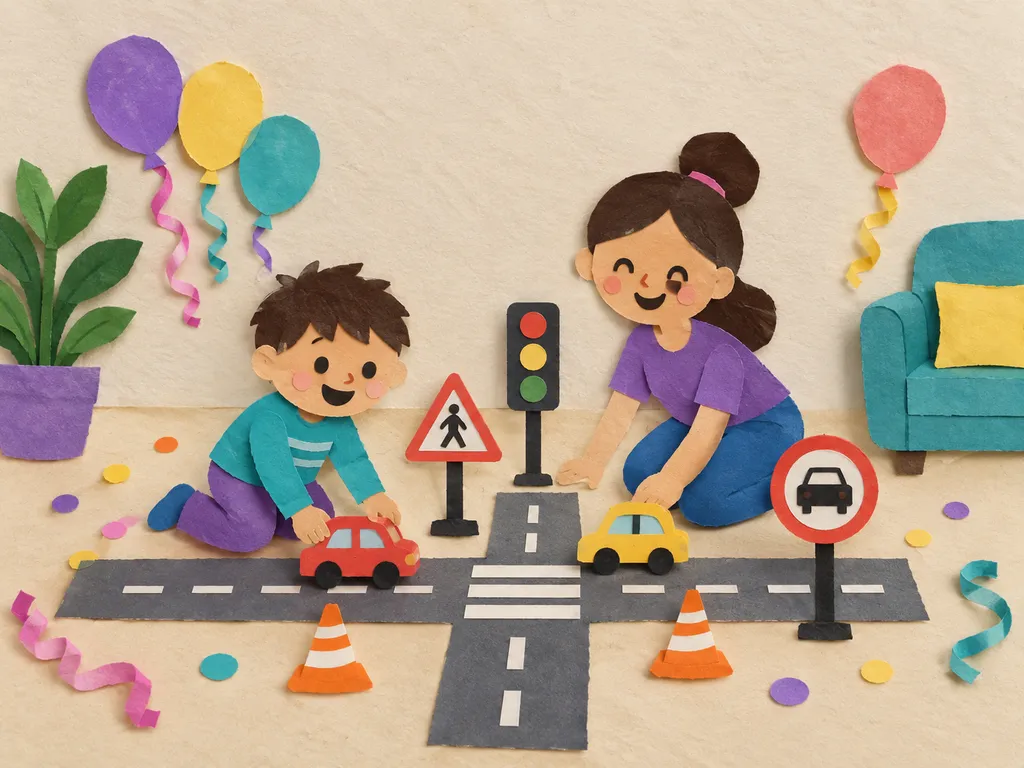
Practise briefly across the week. Sort words into people, places, objects and actions, then describe a street picture. During a supervised walk, notice familiar features without creating a test. Two accurate sentences beat twenty rushed answers.
Safe Route Language Challenge
Draw a road, pavement, marked walkway, signal light and two vehicles. Guide a paper pedestrian across the picture using at least five target words. Change one detail, such as the signal or bicycle position. Your child explains the pedestrian’s next action and reason.
Review Road Safety Vocabulary in English: Words and Activities for Kids through recall instead of copying. Hide a picture card and ask for its name, remove an object from a scene, or match a definition to its word. LearnLink tutors can adapt speaking practice to each learner’s age, language level and response time.
Common Language and Teaching Mistakes
Do not label whole places safe or dangerous. A crosswalk may support safer travel, but children must observe current conditions and follow adult guidance. Practise precise statements: “A vehicle is approaching” or “We cannot see clearly here.”
- Mixing up road and street: A street usually has buildings beside it; road is the broader term.
- Confusing driver and passenger: The driver controls the vehicle; passengers travel in it.
- Saying go instead of cross: Use cross when moving from one side of a road to the other.
- Learning nouns only: Pair each object with verbs such as wear, fasten, wait and check.
- Correcting regional vocabulary: Treat sidewalk and pavement as useful varieties, not as a right and wrong pair.
Do not practise word recall near moving vehicles. Rehearse first with pictures or a model street. In real settings, safety and adult supervision take priority. A child searching for an English word should not make a road decision simultaneously.
- Practice five road safety words with children aged six to eight daily.
- Use a picture book to clarify confusing words like pavement and crossing.
- Role-play three street scenarios and model complete safety sentences before correcting mistakes.
- Ask one question whenever you reach the kerb, then praise clear and accurate answers.
- Review errors gently using word cards, gestures, and spaced repetition for seven days.
When a word has several meanings or pronunciations, Cambridge Dictionary is a useful check before turning it into child-friendly examples.
Frequently Asked Questions
Use these answers to set the pace and connect practice with your community’s road rules.
Which Road Safety Words Should a Child Learn First?
Start with visible words: road, pavement or sidewalk, traffic light, crossing, car, pedestrian, stop, wait, look and listen. Add seat belt and helmet for travel. Next introduce junction, lane, cyclist and passenger. A small working set supports stronger speech than an isolated long list.
How Can Our Tutors Teach Road Safety Vocabulary Without Going Outside?
Use a toy street, hand-drawn map or photos of familiar road features. Your child can point, follow instructions and guide a paper pedestrian. Road Safety Vocabulary in English: Words and Activities for Kids works through short speaking tasks linking each word to an object, action or decision.
Should My Child Learn British or American Road Words?
Teach the form used at school or locally, then introduce alternatives. Children may encounter pavement and sidewalk, or crosswalk and zebra markings. Understanding both helps multilingual families and access to international media. Children need not use every regional form in one sentence.
How Often Should We Practise These Words?
Practise for five to ten minutes several times across the week, matching your child’s age and attention. Revisit words by sorting cards, labelling a map, following instructions and explaining pictures. Stop while engagement remains high. Regular recall strengthens access more than one long session without review.
A short one-to-one lesson can show what level and pace fit your child — book a trial English lesson.
Stay updated on our latest tips and resources by following us on Instagram LearnLink.